WHY MAKE IT
A little comfort, a lot of flavor.
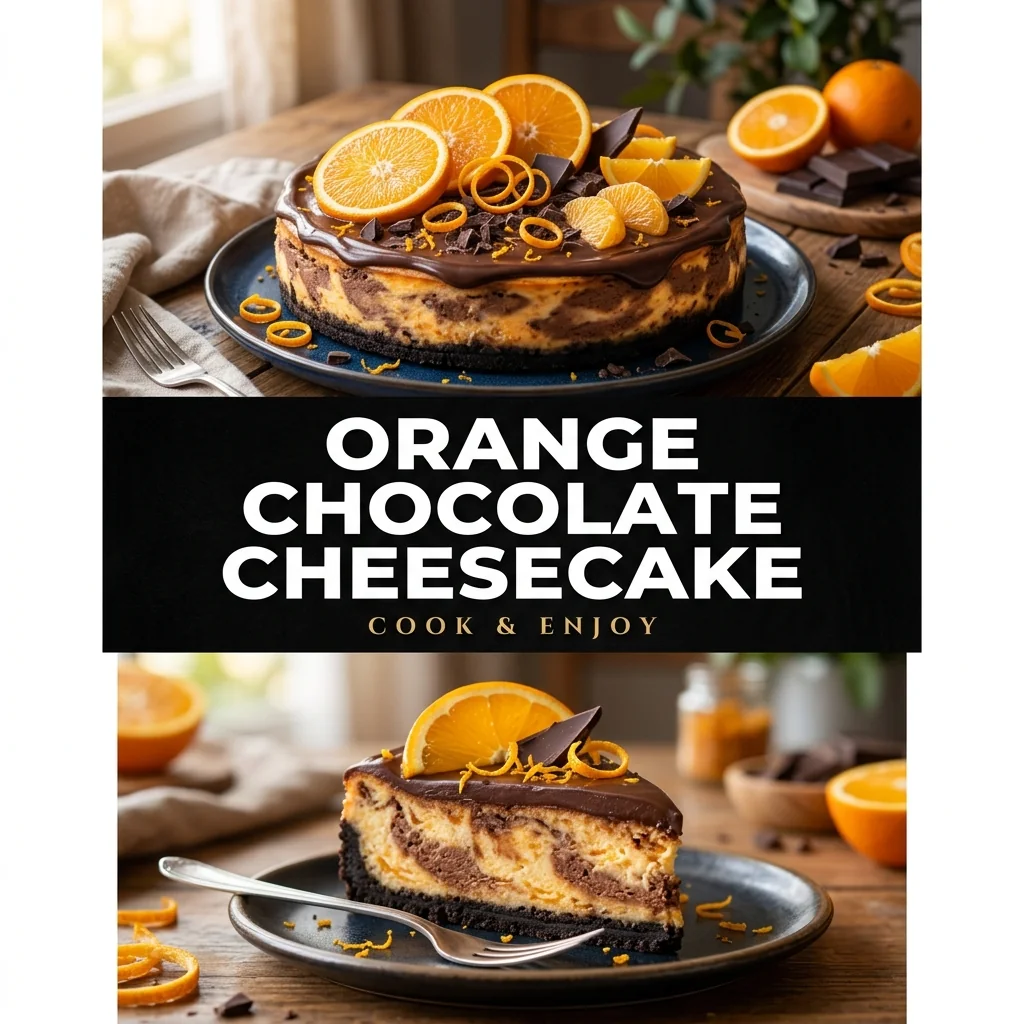
Orange and dark chocolate provide a timeless dessert pairing, marrying the bright, aromatic oils of fresh citrus with the deep, bittersweet undertones of roasted cacao. This baked cheesecake relies on a dense, velvety cream cheese foundation balanced with natural orange zest and Dutch-process cocoa powder, avoiding artificial extracts in favor of clean fruit flavor. A gentle water bath ensures even heat transfer, eliminating cracked surfaces and dry edges while keeping the interior rich and custard-like. Finished with a thin crown of bittersweet ganache, the cake provides textural contrast between the crisp crumb base, smooth filling, and glossy top glaze. It serves as an impressive centerpiece for dinner gatherings, holiday tables, and formal celebrations where make-ahead convenience is prized.
Balancing Citrus Oils and Dark Cocoa
The flavor architecture relies heavily on orange zest rather than juice alone. Citrus zest contains concentrated essential oils that deliver fragrant top notes without altering the moisture ratio or curdling the dairy emulsion. Freshly squeezed juice provides just enough acidity to cut through the heavy milk fats of cream cheese, while Dutch-process cocoa powder contributes an earthy, balanced bitterness. Choose premium bittersweet chocolate with roughly 60% cacao solids to maintain structure; chocolates with higher sugar content can soften the filling excessively, while extreme dark chocolates above 75% can cause the batter to bake up chalky.
Water Bath Precision and Cooling Protocol
Baking cheesecake gently within a hot water bath, or bain-marie, buffers the delicate egg proteins against sudden temperature spikes. The water moderates heat around the lower pan walls, helping the filling bake gently. Sudden temperature drops cause cheesecakes to shrink rapidly and fissure across the top. Allowing the baked custard to cool inside the switched-off oven for a full hour tempers this transition. The extended chilling phase in the refrigerator completes the setting process, allowing dairy butterfat and cocoa butter to firm up to their intended slicing density.
Slicing Technique and Presentation
Dense chocolate cheesecakes cling readily to metal blades if sliced carelessly. To maintain crisp edges, dip a long, thin-bladed chef's knife into a tall container of very hot water, then dry the blade thoroughly on a clean kitchen towel before making each single cut. Press straight down through the ganache, filling, and crust in one continuous motion, then slide the blade out horizontally along the base rather than pulling it back upward. Garnish each portion with candied orange peel curls or a sprinkle of flaky sea salt just before serving to accent the chocolate aroma.
Before you start
Room temperature ingredients are critical for preventing lumps in chocolate cheesecake. If cream cheese is cold, it will not blend cleanly with melted chocolate, causing the cocoa fats to seize into grainy specks. Melt the bittersweet chocolate early so it cools to lukewarm (roughly 90°F to 95°F / 32°C to 35°C) before streaming it into the cheese mixture. Run your chef's knife under hot tap water and wipe dry between every slice to achieve neat, professional cuts.
THE RECIPE
Orange Chocolate Cheesecake
12 servings · 35 minutes preparation · 73 minutes cooking · 437 minutes cooling, chilling or resting
Ingredients
Step-by-step instructions
- Position an oven rack in the center position and preheat the oven to 325°F (163°C). Lightly grease a 9-inch (23 cm) springform pan and line the bottom with a circle of parchment paper. Wrap the outside of the pan securely with three overlapping layers of heavy-duty aluminum foil to guard against leaks during baking.
- Combine the finely crushed chocolate sandwich cookies and melted unsalted butter in a small bowl until uniformly moistened. Press the crumb mixture firmly and evenly into the bottom of the prepared springform pan using the flat bottom of a drinking glass. Bake for 10 minutes at 325°F (163°C), then transfer the pan to a wire rack to cool completely.
- In a large bowl using an electric stand mixer fitted with the paddle attachment, beat the softened cream cheese on medium-low speed for 2 minutes until completely smooth, scraping the sides and bottom of the bowl. Gradually add the granulated sugar, sifted cocoa powder, and kosher salt, mixing on low speed until homogeneous and lump-free.
- Stir the melted bittersweet chocolate, finely grated orange zest, fresh orange juice, vanilla extract, and 60 ml heavy cream into the batter on low speed until combined. Add the eggs one at a time, mixing on the lowest speed just until each yolk disappears, taking care not to incorporate excess air into the dense batter.
- Pour the chocolate orange filling into the cooled crust and smooth the top with an offset spatula. Place the foil-wrapped springform pan into a large, high-sided roasting pan. Pour boiling water into the roasting pan until it reaches halfway up the side of the springform pan, creating a gentle water bath.
- Bake at 325°F (163°C) for 55 to 60 minutes, until the outer three inches appear set and slightly puffed, but the center 2-inch circle still wobbles gently when tapped. Check that the center reaches 160°F (71°C) on an instant-read thermometer, continuing to bake as needed before turning the oven off. Turn off the oven, prop the oven door open approximately 2 inches with a wooden spoon, and let the cheesecake rest undisturbed inside the warm water bath for 60 minutes.
- Remove the cheesecake from the water bath, strip away the outer foil wrap, and set the springform pan on a wire cooling rack at room temperature for 60 minutes. Run a thin, flexible offset spatula or pairing knife around the inner perimeter to loosen the edge, preventing tears as the cake contracts.
- Cover the pan loosely with plastic wrap and transfer it to the refrigerator to chill for at least 5 hours (300 minutes), or overnight, until fully set and thoroughly chilled. Once chilled, gently release the springform collar and smooth the exposed sides if necessary.
- Prepare the topping by placing 120 g bittersweet chocolate chips into a heatproof bowl. Warm 80 ml heavy cream in a small saucepan over medium heat just until simmering, pour it over the chocolate, let stand for 2 minutes, then whisk until smooth; pour the warm ganache over the chilled cheesecake surface, spread evenly, and chill for 15 minutes before slicing.
Kitchen notes
Room temperature ingredients are critical for preventing lumps in chocolate cheesecake. If cream cheese is cold, it will not blend cleanly with melted chocolate, causing the cocoa fats to seize into grainy specks. Melt the bittersweet chocolate early so it cools to lukewarm (roughly 90°F to 95°F / 32°C to 35°C) before streaming it into the cheese mixture. Run your chef's knife under hot tap water and wipe dry between every slice to achieve neat, professional cuts.
Storage & make-ahead
Cover leftover cheesecake tightly with plastic wrap or store slices in an airtight container in the refrigerator at or below 40°F (4°C) for up to 4 days. Promptly refrigerate all perishable dairy slices within 2 hours of serving. Slices may be wrapped individually in plastic and aluminum foil and frozen for up to 2 months; thaw frozen cheesecake overnight in the refrigerator before serving. Do not reheat this dish.
An original recipe guide inspired by themes in our Pinterest research. Recipe has not been independently kitchen-tested. AI-generated image is illustrative; your finished dish may look different.
Frequently asked questions
Can I substitute orange extract instead of fresh orange zest?
You can substitute 2.5 ml of pure orange oil or orange extract if fresh fruit is unavailable. However, fresh zest yields a brighter, more natural floral aroma without the harsh medicinal aftertaste sometimes present in concentrated commercial extracts.
Why did my springform pan leak water into the crust?
Standard springform pans are rarely watertight. Always encase the exterior with multiple wide sheets of heavy-duty foil, or set the springform pan inside an oven-safe 10-inch silicone cake pan before resting it in the hot water bath.
How do I know when the cheesecake is finished baking?
Gently nudge the side of the pan with an oven mitt. The outer edges should appear matte, firm, and slightly puffed, while the inner 2 inches should wobble like set gelatin. An instant-read thermometer inserted into the center should read 160°F (71°C).